
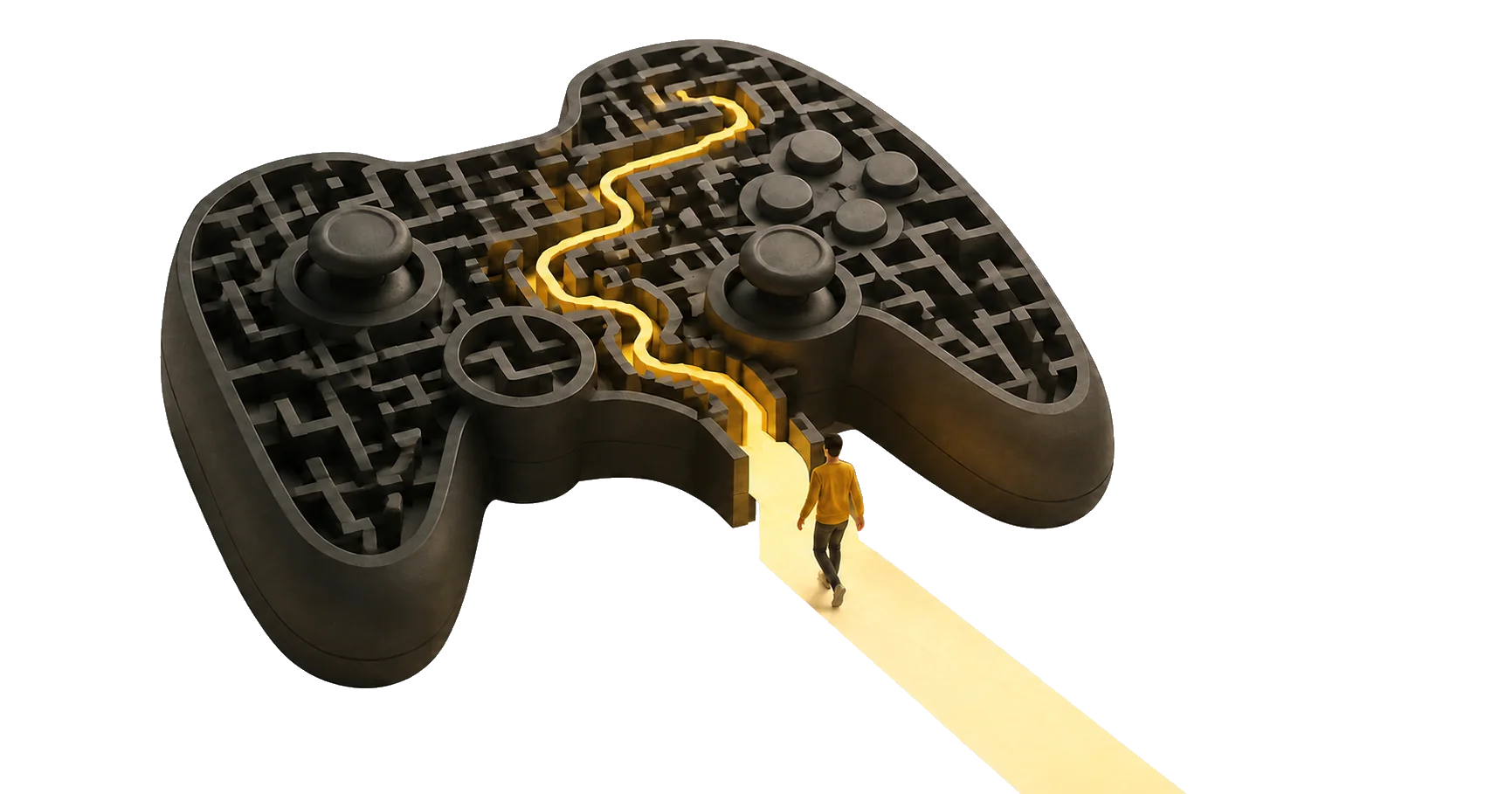
Games are designed to make progress easy to understand.
You know the objective. You receive immediate feedback. You can see yourself improving. Even failure gives you useful information for the next attempt.
Real life rarely works that way.
You can work for weeks without knowing whether you are getting closer to your goal. Important tasks are often unclear, uncomfortable and slow to reward you. Gaming becomes especially difficult to control when it offers progress, confidence and connection that are missing elsewhere.
The goal, therefore, is not simply to play fewer games. It is to understand what keeps pulling you back and build a life that can compete for your attention.
Here are four practical ways to begin.
1. Measure the damage, not just the hours
Playing for several hours does not automatically mean you have a gaming problem. Someone may play extensively without neglecting their responsibilities, while another person’s shorter sessions may consistently damage their sleep, work or relationships.
The more useful questions are:
- Are you repeatedly playing longer than you intended?
- Are you postponing important work to play?
- Is gaming affecting your sleep?
- Have you lost interest in activities you previously enjoyed?
- Do you continue playing despite problems it is causing?
- Have you tried to reduce your gaming and repeatedly failed?
The World Health Organization identifies impaired control, increasing priority given to gaming and continued play despite negative consequences as the central features of gaming disorder. This does not mean everyone who games heavily has a disorder. It gives us a better way to evaluate whether gaming is becoming harmful. Read the WHO explanation.
For one week, record when you start, when you stop and what you postpone.
Do not estimate. Write it down.
You may discover that the issue is not gaming every day. It might be gaming after midnight, playing whenever work becomes difficult or turning a short break into an entire afternoon.
A specific pattern is easier to change than a vague feeling that you “play too much.”
2. Identify the need gaming is meeting
People do not only play games because games are entertaining.
Games can provide:
- Achievement
- Competition
- Social connection
- Relief from stress
- A sense of control
- Escape from difficult emotions
- Visible and predictable progress
Research has found that escapism and using gaming to cope with negative emotions are strongly associated with problematic gaming symptoms. Achievement and social motivations can also contribute. Review the research on gaming motivations.
Ask yourself:
What becomes easier for me when I am playing?
Perhaps you stop thinking about money. You feel capable. You have people to talk to. You receive recognition. You know exactly what to do next.
Your answer tells you what must be addressed outside the game.
If gaming is your main social activity, reducing it without creating another source of connection may leave you isolated.
If it provides achievement, you need real-world goals with visible progress.
If it helps you avoid anxiety, removing the game will not resolve the work, conversation or decision creating that anxiety.
Do not leave an important need empty. Find a healthier way to meet it.
3. Replace unlimited gaming with a defined session
“Play less” is too vague to work.
A better plan answers four questions:
- When will I begin?
- When will I stop?
- What is my final match?
- What will I do immediately afterward?
For example:
I can play between 7:30 and 9:00 p.m. I will not start another match after 8:40. When I finish, I will shut down the computer and prepare for tomorrow.
The final-match rule matters because many games do not end neatly when your alarm rings. If you decide when to stop only after finishing a match, “one more” remains available forever.
Make the boundary easier to follow:
- Set an alarm before your final match.
- Disable automatic game launches.
- Remove games from devices you use for work.
- Avoid gaming in bed.
- Tell teammates when you plan to leave.
- Keep controllers and gaming devices out of immediate reach when the session ends.
These changes are not punishments. They create a pause between wanting to play and automatically opening the game.
Identifying triggers, monitoring behaviour and planning different responses are common elements in cognitive behavioural approaches to problematic gaming. Research suggests these interventions can help, although the quality and strength of evidence vary between studies. See the review of randomized trials.
4. Make real-world progress easier to see
A game might show your rank, experience points, completed missions and the exact requirements for your next reward.
Your real goals may exist as statements like:
- Get a better job
- Build my business
- Improve my health
- Finish my course
These are directions, not actions. Their size and uncertainty make gaming more attractive.
Convert them into actions you can finish:
- Improve one section of my CV.
- Contact one potential customer.
- Walk for 20 minutes.
- Complete one lesson.
- Write 200 words.
- Send the email I have been avoiding.
Track these actions somewhere visible.
You can also use gaming as a reward instead of allowing it to interrupt the work:
After completing my most important task, I can play for one planned session.
The objective is not to turn your whole life into a game. It is to stop making real progress invisible.
When self-imposed limits are not enough
Some people can regain control by changing their schedule and environment. Others may need professional support.
Consider speaking with a qualified mental-health professional if gaming is seriously affecting your education, work, health, relationships or finances—especially if repeated attempts to reduce it have failed.
Cognitive behavioural therapy is one of the most studied psychological approaches for problematic gaming. Reviews also suggest potential benefits from mindfulness and family-supported interventions, although more high-quality research is still needed. Read the treatment review.
Seeking support is not an overreaction. Once a behaviour is repeatedly harming your life and feels outside your control, getting help is a practical response.
Start with one week, not forever
Do not begin by promising never to play another game.
Run a seven-day experiment:
- Track every gaming session.
- Complete one important task before playing.
- Set a final-match time.
- Protect your normal sleeping time.
- Replace one gaming session with another rewarding activity.
- Review what caused you to break your limits.
At the end of the week, you will have something more useful than guilt: evidence.
You will know when you are most vulnerable, what gaming provides for you and which boundaries you can realistically maintain.
The aim is not to prove that you can live without games.
It is to make sure you are still building a life you do not constantly need to escape from.